If you've ever searched for a therapist and found yourself staring at a screen full of letters- LICSW, LCSW, LMHC, LMFT, PMHNP, PMH-C- you are not alone. I call it the alphabet soup of acronyms and it can make an already vulnerable step feel even more overwhelming.
Here's the good news: those letters actually tell you a lot. They tell you how a provider was trained, what they're allowed to do, and sometimes what they've chosen to specialize in. Once you know how to read them, you can find someone who fits what you need- whether that's weekly therapy, medication support, help in your relationship, or specialized care during pregnancy and postpartum.
Let's break it down together.
The therapists: social workers, counselors, and family therapists
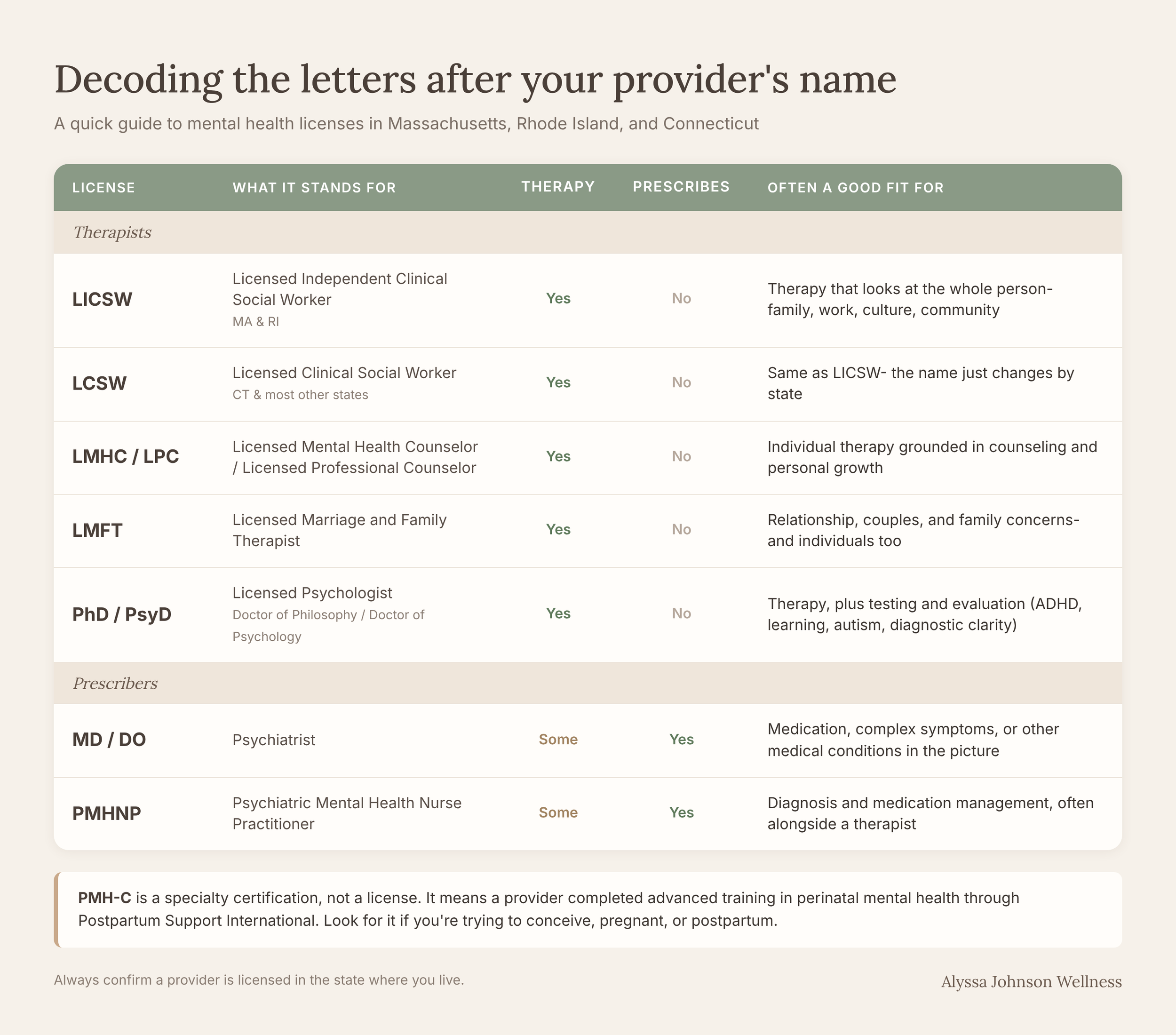
All of these providers offer talk therapy. They hold a master's degree, completed years of supervised clinical work after graduate school, and passed a licensing exam. What differs is the lens they trained through.
Why am I an LICSW in one state and an LCSW in another?
This is the one that confuses almost everyone- including other clinicians. I'm the same social worker with the same training whether you see me in Massachusetts, Rhode Island, or Connecticut. Each state simply names its licenses differently.
In Massachusetts, "LCSW" means Licensed Certified Social Worker- a master's-level license that requires supervision for clinical work. The independent clinical license, the highest level, is the LICSW. Rhode Island uses LICSW too.
In Connecticut, like most of the country, the independent clinical license is called the LCSW- Licensed Clinical Social Worker.
So if you're comparing providers in Massachusetts, LICSW is the license that means a social worker can practice therapy independently. In Connecticut, look for LCSW.
What about counselors and family therapists?
An LMHC (or LPC in Connecticut) trained specifically in counseling. Many are wonderful generalists, and many go on to specialize in trauma, anxiety, or substance use.
An LMFT sees problems through the lens of relationships. If what's weighing on you lives mostly between you and your partner, or within your family, an LMFT can be a great fit- though they see individuals too.
Honestly, for most people the license matters less than the fit. A licensed social worker, counselor, or family therapist can all provide excellent therapy. What matters more is their specialty, their approach, and whether you feel safe with them.
The psychologists: PhD and PsyD
A licensed psychologist holds a doctoral degree, typically a PhD (Doctor of Philosophy) or a PsyD (Doctor of Psychology). Like social workers, counselors, and family therapists, psychologists provide therapy- many see clients for weekly individual, couples, or family sessions. They complete years of graduate training, a supervised internship, and postdoctoral hours before licensure.
The difference is mostly in emphasis. A PhD program leans toward research and science, while a PsyD program leans toward clinical practice and working directly with clients. Both can be excellent therapists.
Beyond therapy, psychologists are also trained in psychological testing and assessment. If you're looking for an evaluation- for ADHD, learning differences, autism, or a clearer picture of a complex diagnosis- a psychologist is usually who you'll see. Psychologists do not prescribe medication in Massachusetts, Rhode Island, or Connecticut.
One note: "Dr." doesn't always mean psychologist. A provider with a doctorate in another field, like social work (DSW) or counseling, may also use the title. And not everyone who calls themselves a "therapist" is a psychologist- the license is what tells you.
The prescribers: psychiatrists and psychiatric nurse practitioners
If you're wondering whether medication might help, you'll want a prescriber. These providers focus on diagnosis and medication management, and appointments are usually shorter and less frequent than therapy.
Psychiatrist (MD or DO): a medical doctor who completed residency in psychiatry. Often the right choice for complex symptoms, multiple medications, or when other medical conditions are in the picture.
Psychiatric nurse practitioner (PMHNP): an advanced practice nurse with graduate training in psychiatric care who can diagnose and prescribe. Many people find them easier to get in with and appreciate their whole-person nursing approach.
It's not either/or. Many of my clients work with a prescriber and a therapist. Medication can quiet the volume on anxiety or depression enough that therapy can really land, and therapy builds the skills and insight that medication alone can't. When both providers communicate (with your permission), your care feels connected rather than scattered.
A quick way to think about it: a therapist helps you understand and change what you're experiencing; a prescriber helps your brain and body have the support they need to do that work.
The specialty letters: what is a PMH-C?
A license tells you what someone is allowed to do. A certification tells you what they've chosen to go deep in.
The PMH-C is the Perinatal Mental Health Certification from Postpartum Support International, the world's largest nonprofit focused on mental health during pregnancy and postpartum. It was first offered in 2018, and earning it means completing specialized perinatal training on top of a professional license and passing a certification exam. In June 2026, the program earned accreditation from the National Commission for Certifying Agencies.
Why it matters
The perinatal period- from trying to conceive through pregnancy and the first year after birth- is its own world. Postpartum anxiety can look like constant checking or intrusive thoughts. Postpartum depression doesn't always look like sadness. Birth trauma, fertility struggles, pregnancy loss, and the identity shift of becoming a mom all deserve someone who understands them.
A provider with a PMH-C knows these patterns, knows the screening tools, and knows which symptoms need a faster response. Just as important, you won't spend your first few sessions explaining why that intrusive thought scared you so much.
You'll see PMH-C after the names of therapists, prescribers, nurses, and other professionals who support moms. If you're pregnant, postpartum, or trying to conceive, it's one of the most useful letters to look for.
So who should you see?
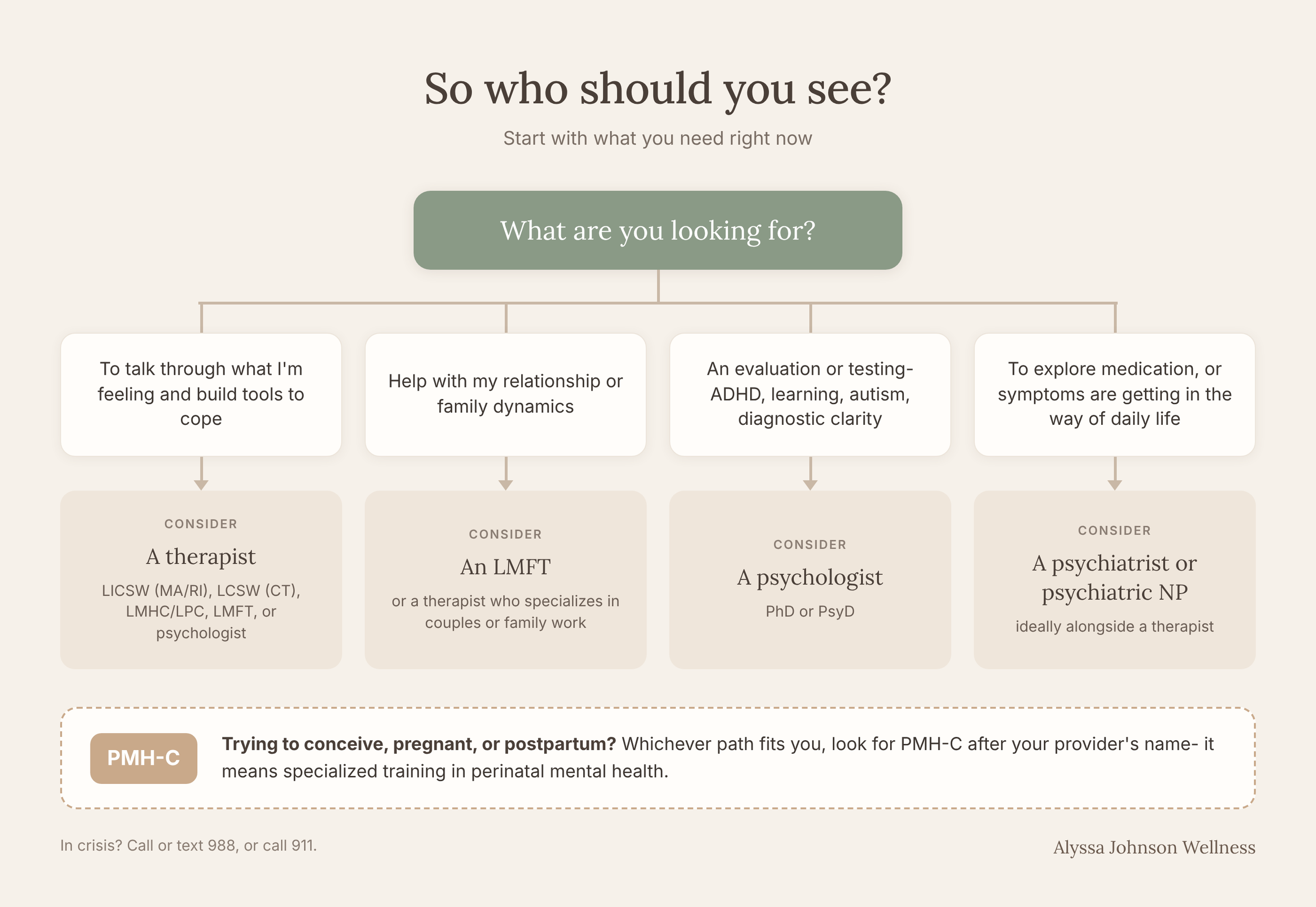
Start with what you need right now:
You want to talk through what you're feeling and build tools to cope: an LICSW (MA/RI), LCSW (CT), LMHC/LPC, LMFT, or psychologist.
You need an evaluation or testing (ADHD, learning, autism, diagnostic clarity): a psychologist (PhD or PsyD).
Your relationship or family dynamics are at the center of it: consider an LMFT, or a therapist who specializes in couples or family work.
You're wondering about medication, or symptoms are getting in the way of daily life: a psychiatrist or psychiatric nurse practitioner- ideally alongside a therapist.
You're trying to conceive, pregnant, or postpartum: look for PMH-C after their name.
A few practical tips as you search:
Check that they're licensed where you live. Therapists can only see you, even by telehealth, in a state where they hold a license and where you're physically located during the session.
Look up their license. Every state board has a free online lookup, and it's a quick way to confirm someone is in good standing.
Ask about fit. Most therapists offer a short consultation call. Use it to ask how they work and notice how you feel talking with them.
The letters can help you narrow your search, but the relationship is what helps you heal.
Allow me to introduce myself

I'm Alyssa Johnson, LICSW, PMH-C- licensed as an LICSW in Massachusetts and Rhode Island and an LCSW in Connecticut. I support women through every stage of motherhood, from trying to conceive through postpartum and beyond, weaving holistic practices like Reiki, yoga, and nervous system regulation into evidence-based therapy.
If you're wondering whether we might be a good fit, I'd love to connect- schedule a free 15-minute consultation or follow along on Instagram.